rvmusa
Rolex Submariner Ref.5512 Gilt Silver Text Chapter Ring Exclamation PCG Tropical Caramel from 1962
Rolex Submariner Ref.5512 Gilt Silver Text Chapter Ring Exclamation PCG Tropical Caramel from 1962
This watch is a rare 1962 Rolex Submariner reference 5512. During this period, Rolex produced the reference 5513 alongside the 5512. The latter featured a chronometer-certified movement, but aside from that, the two references were essentially the same watch.
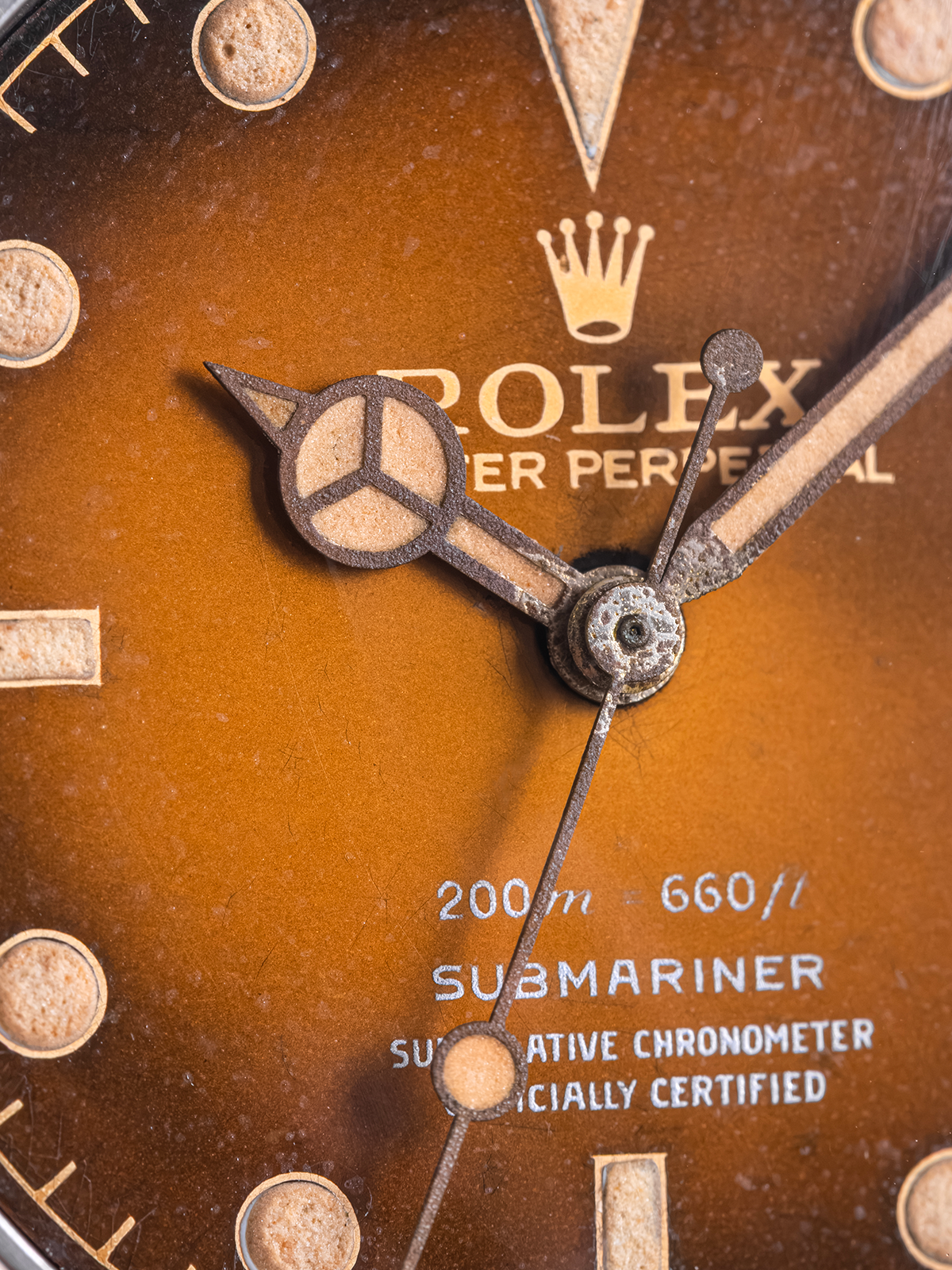
In 1961, Rolex began printing the chronometer certification text on the dial to distinguish the 5512 from the 5513. For this reason, this particular watch features the characteristic four lines of text. While most 1961 and 1962 examples can be found with fully gilt printing, this watch has the much rarer two-color dial configuration, combining gilt and silver text. The contrast looks especially beautiful against the aged tropical caramel dial.
Another remarkable feature is the chapter ring, a design element reminiscent of earlier Submariner models. In 1963, Rolex began producing dials without the chapter ring, making these earlier examples particularly desirable.
The "exclamation dial" refers to the small luminous dot below the 6 o'clock marker. It is generally believed that this indicated a reduced amount of radium in the luminous material during Rolex's transition toward tritium. By 1964–1965, Rolex had begun printing "Swiss T<25" on the dial to indicate the use of tritium. This watch currently measures approximately 2.5 CPS on a Geiger counter, which is very similar to the reading we obtained from a reference 5508 from the same year.
Now, regarding the "PCG" designation, this refers to the pointed crown guards, a defining characteristic of early 5512s. They give these Submariners an elegant and unmistakable profile that many collectors consider among the most attractive of all Submariner generations.
The bezel is the correct Mk2 fat-font, sans-serif insert and has faded to a beautiful brownish-gray tone that perfectly complements the aged dial. The dial itself has developed a rich caramel tropical hue, darker around the outer edge and lighter toward the center. It remains free of spider cracking and retains a glossy finish with only very very minor blemishes. The lume on both the dial and hands is completely original, with no repairs or reluming, displaying an even texture and a deep vanilla color acquired over decades of aging.
The bracelet is a folded riveted Oyster bracelet fitted with a Mexican-made clasp. During the mid-20th century, Mexico adopted an Import Substitution Industrialization (ISI) policy, which encouraged imported products to incorporate locally manufactured components. This policy reached its peak during the early 1960s, and one of Rolex's notable partners was Grupo Joske's of Mexico, a jewelry manufacturer that produced clasps and Jubilee bracelets exclusively for the Mexican market. The clasp is correctly stamped "Hecho en Mexico."
The bracelet also has a newer solid Oyster link that was installed by the previous owner so the watch would fit his son's wrist when he gave it to him as a gift about ten years ago. Years later, the son contacted us from a small rural town near Querétaro to sell this family heirloom. He wanted to free up some funds to pay for breast implants for his younger girlfriend.
After completing the purchase, inspecting the movement, and carefully examining the dial, we decided to leave the replacement Oyster link exactly as we received it. It can easily be removed, but keeping it on the watch preserves a small part of its story. It serves as a reminder that these watches have lives before us—each carrying their own history, decisions, and memories long before they reach the next collector.